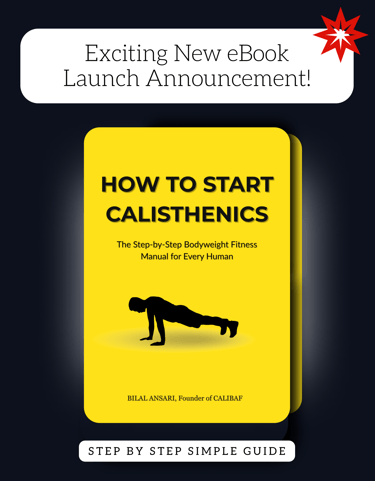
HOW TO START CALISTHENICS
The Complete Beginner’s Guide
Want to start calisthenics but don’t know where to begin? You’re in the right place.
This guide will take you from complete beginner to having a clear understanding of how calisthenics works, what exercises to learn first, how to structure your workouts, how to progress, and how to eventually learn advanced skills.
You don’t need to be strong.
You don’t need to be flexible.
You don’t need a gym membership.
And you definitely don’t need to be able to do a pull-up on your first day.
You just need to start.
Welcome to calisthenics.
What Is Calisthenics?
Calisthenics is a form of physical training that primarily uses your body weight as resistance.
Instead of relying mainly on machines or barbells, you learn to control, move, and strengthen your body through movements such as:
Push-ups
Pull-ups
Squats
Lunges
Dips
Rows
Planks
Handstands
Muscle-ups
L-sits
And many other movements and skills
Calisthenics can be practiced almost anywhere—at home, outdoors, in a calisthenics park, or in a dedicated training facility.
But calisthenics is more than simply doing bodyweight exercises.
The goal is to develop strength, movement control, coordination, mobility, endurance, and eventually the ability to perform increasingly difficult skills with your own body.
That is what makes calisthenics so rewarding.
Can Anyone Start Calisthenics?
Yes.
You don’t need to be young, athletic, muscular, thin, flexible, or already fit to begin.
A beginner who cannot perform a single push-up can start with an easier variation.
Someone who cannot do a pull-up can start with rows, assisted pull-ups, hangs, and controlled negatives.
Someone who finds bodyweight squats difficult can begin with a supported squat and gradually build strength.
Calisthenics is not one exercise. It is a system of progressions.
The exercise should match your current ability—not the other way around.
If you’re starting from zero, your first goal isn’t to perform impressive skills.
Your first goal is to build a foundation.
Why Start Calisthenics?
There are many reasons people start calisthenics.
1. You can train almost anywhere
You can train at home, outdoors, in a park, or in a gym.
You can begin with little or no equipment.
2. It develops relative strength
Because you’re learning to control your own body, calisthenics develops strength relative to your bodyweight.
3. It can build muscle
Bodyweight exercises can provide resistance sufficient to build muscle, particularly when you’re starting out. As you become stronger, you’ll need to progressively increase the challenge through harder variations, additional volume, tempo changes, leverage changes, or external resistance.
4. It improves body control
Calisthenics teaches you to control your body through space.
Over time, you may develop skills such as:
Handstand
L-sit
Muscle-up
Front lever
Back lever
Human flag
Planche
5. It is scalable
Almost every fundamental movement can be made easier or harder.
That means the same basic movement patterns can serve a complete beginner and an advanced athlete.
The Most Important Concept: Start Where You Are
One of the biggest mistakes beginners make is copying advanced athletes.
You see someone doing:
Muscle-ups → handstands → planche → human flag
and think:
“That’s calisthenics. I need to learn those.”
No.
Those are advanced expressions of calisthenics.
Your first training session might simply contain:
Squat → Push → Pull → Core
That’s enough.
Your job is to gradually make those movements stronger and more controlled.
The 5 Fundamental Movement Patterns
Before worrying about advanced skills, learn the foundations.
A simple way to organize beginner calisthenics is around fundamental movement patterns.
1. Squat
Examples:
Bodyweight squat
Assisted squat
Split squat
Reverse lunge
Bulgarian split squat
These develop your lower body.
2. Push
Examples:
Wall push-up
Incline push-up
Knee push-up
Push-up
Decline push-up
Pike push-up
These train pushing strength through the chest, shoulders, triceps, and supporting musculature.
3. Pull
Examples:
Australian/inverted row
Assisted pull-up
Negative pull-up
Chin-up
Pull-up
Pulling strength is one of the most important foundations for calisthenics.
If you cannot do a pull-up yet, that’s completely normal.
Start with an appropriate progression.
4. Hinge
Examples:
Glute bridge
Hip hinge
Single-leg bridge
Nordic curl progression
The hinge pattern helps develop the posterior chain.
5. Core
Examples:
Plank
Side plank
Dead bug
Hollow-body hold
Hanging knee raise
L-sit progression
Your core isn’t just about getting visible abs.
It helps you transfer force and control your body during many calisthenics movements.
The Beginner Calisthenics Exercises
If you’re completely new, don’t worry about learning dozens of exercises.
Start with a small number of movements and learn them well.
Upper-body pushing
Incline push-up → Push-up → harder push-up variations
Upper-body pulling
Inverted row → Assisted pull-up → Negative pull-up → Pull-up
Lower body
Squat → Split squat → Single-leg progressions
Core
Plank → Hollow hold → Hanging progressions → L-sit progressions
The exact progression depends on your current strength.
There is no universal starting level.
How to Know Which Progression to Choose
This is one of the most important ideas in calisthenics:
Choose the hardest variation you can perform with good technique and control.
Not the hardest variation you’ve seen on Instagram.
Not the exercise your friend is doing.
Not the exercise that looks impressive.
Your current level determines your starting point.
For example:
Push-up progression
Wall push-up
↓
Incline push-up
↓
Knee push-up / modified push-up
↓
Push-up
↓
Decline push-up
↓
Archer push-up
↓
One-arm push-up progressions
You don’t need to rush through these.
Master your current level and gradually increase the challenge.
Your First Calisthenics Workout
If you’re a complete beginner, start simple.
Beginner Full-Body Workout
Warm-up — 5–10 minutes
Then:
1. Squat
2–3 sets × 8–15 reps
2. Incline or regular push-up
2–3 sets × 5–12 reps
3. Inverted row or assisted pull-up
2–3 sets × 5–12 reps
4. Reverse lunge
2–3 sets × 6–12 reps per leg
5. Plank
2–3 sets × 20–45 seconds
Rest as needed between sets.
The numbers above are a starting point, not a rule carved in stone.
Quality comes first.
If you cannot perform the suggested variation with good form, make the exercise easier.
If it becomes very easy, progress to a more challenging variation.
How Many Days a Week Should a Beginner Train?
For most beginners, 2–3 strength-training sessions per week is a practical starting point.
You could train:
Monday — Full Body
Wednesday — Full Body
Friday — Full Body
This gives you recovery days between sessions.
As you gain experience, your training frequency and structure can change according to your goals, recovery, schedule, and overall training volume.
You don’t need to train every day to make progress.
Consistency beats intensity.
How Long Should a Calisthenics Workout Last?
You don’t need a two-hour workout.
A beginner session can often be completed in approximately 30–60 minutes, depending on warm-up, rest periods, skill work, and the number of exercises.
Your objective isn’t to spend as much time as possible exercising.
Your objective is to perform useful training consistently and recover well enough to come back stronger.
Progressive Overload: How You Actually Get Stronger
This is the principle that separates random exercise from structured training.
Your body adapts to training.
If you always perform exactly the same workout at exactly the same difficulty, eventually your progress will slow.
You therefore need to gradually increase the challenge.
This is called progressive overload.
In calisthenics, you can progress by:
Increasing repetitions
Increasing sets
Improving technique
Increasing range of motion
Using a harder variation
Changing leverage
Increasing time under tension
Adding external resistance
Reducing assistance
Increasing control
For example:
Incline push-up
→ lower incline
→ knee push-up
→ regular push-up
→ decline push-up
→ harder variation
The exercise changes as you become stronger.
That’s the beauty of calisthenics:
Your body becomes the equipment, and progression becomes the program.
Don’t Train to Failure Every Time
You don’t need to destroy yourself during every workout.
For beginners, leaving some repetitions “in reserve” can make training more manageable and help maintain technique.
If your push-up form falls apart after repetition 7, don’t force yourself to complete 15 ugly repetitions just because a program says “15.”
Stop, rest, or choose an appropriate variation.
Good repetitions build skill. Bad repetitions build bad habits.
What About Pull-Ups?
Pull-ups are one of the most iconic calisthenics movements—and one of the most common beginner goals.
But many beginners make the mistake of repeatedly jumping onto a pull-up bar and attempting full pull-ups before they have enough pulling strength.
Instead, build your pulling ability progressively.
A simple progression might look like:
Dead hang
↓
Scapular pull
↓
Inverted row
↓
Assisted pull-up
↓
Negative pull-up
↓
Chin-up
↓
Pull-up
The exact progression will depend on your current ability.
Your first pull-up is not something you have to magically “unlock.”
It is a strength skill you can train toward.
What About Push-Ups?
The same principle applies.
If you can’t perform a full push-up, don’t conclude that you’re “not strong enough for calisthenics.”
Start with an easier variation.
Wall push-up
↓
Incline push-up
↓
Modified push-up
↓
Full push-up
↓
Harder push-up variations
Your goal is not to impress anyone on day one.
Your goal is to make today’s version slightly easier until you’re ready for the next one.
When Should You Start Learning Calisthenics Skills?
You don’t need to wait until you’re an advanced athlete.
But you also shouldn’t let advanced skills replace foundational strength training.
You can begin introducing appropriate skill work once you have enough basic strength and control.
Some beginner-friendly skills and preparations include:
Hollow-body position
Arch-body position
Wall handstand
Frog stand
L-sit progressions
Scapular control
Hanging exercises
Later, you can work toward more advanced skills such as:
Pull-up
Muscle-up
Handstand
Handstand push-up
L-sit
Front lever
Back lever
Human flag
Planche
Skills are destinations. Fundamentals are the road.
How Long Does It Take to See Results?
There is no universal timeline.
Your results depend on factors such as:
Starting fitness level
Training consistency
Nutrition
Sleep
Recovery
Bodyweight
Genetics
Training quality
Your specific goal
You may notice improvements in coordination and exercise performance relatively quickly.
Strength and muscle development take longer and require consistent training.
Advanced skills can take substantially longer.
Don’t measure your progress only by your appearance.
Track:
Can you do more reps?
Can you use a harder progression?
Is your technique better?
Can you control your body better?
Can you hold a position longer?
Those are progress too.
Can You Do Calisthenics at Home?
Absolutely.
You can start with very little equipment.
A beginner can perform many movements using:
Floor space
A wall
A sturdy elevated surface
However, pulling exercises become much easier to train with access to a safe pull-up bar, rings, or another appropriate setup.
If you eventually want to develop advanced calisthenics skills, access to equipment such as:
Pull-up bars
Parallel bars
Rings
Resistance bands
Parallettes
can expand your training options.
You don’t need to buy everything on day one.
Start with what you have.
Do You Need a Gym?
No.
Calisthenics can be performed at home, outdoors, in parks, or in gyms.
In fact, one of the strengths of bodyweight training is that it isn’t tied to one location.
A gym can still be useful, especially when you want:
Additional resistance
Weight-assisted exercises
Leg training
Specific equipment
Structured coaching
The question isn’t:
“Gym or calisthenics?”
The better question is:
“What training environment helps me achieve my goals consistently?”
What Should You Eat When Starting Calisthenics?
You don’t need a magical “calisthenics diet.”
Your nutrition should support your goal.
If your goal is building muscle, you need adequate overall nutrition and protein.
If your goal is losing body fat, your overall energy intake matters.
If your goal is improving performance, you need enough food and recovery to train effectively.
Focus first on the basics:
Eat enough protein
Eat a variety of minimally processed foods
Eat fruits and vegetables
Stay hydrated
Get adequate calories for your goal
Don’t obsess over supplements
Be consistent
Training builds the stimulus. Nutrition and recovery help your body adapt to it.
Recovery Is Part of Training
You don’t get stronger simply because you exercise.
Training provides the stimulus.
Recovery allows your body to adapt.
Prioritize:
Sleep
Aim for sufficient, consistent sleep.
Rest
Give trained muscles time to recover.
Nutrition
Provide your body with the energy and nutrients it needs.
Stress management
Your overall lifestyle affects recovery.
Training quality
More training isn’t automatically better.
Train hard enough to improve, recover well enough to do it again.
The Most Common Beginner Mistakes
1. Starting too hard
You don’t need an advanced routine.
2. Chasing skills too early
A muscle-up isn’t more important than building a strong pull-up.
3. Doing hundreds of repetitions
More isn’t automatically better.
4. Ignoring legs
Calisthenics is full-body training.
Train your lower body.
5. Ignoring pulling movements
Push-ups alone aren’t a complete upper-body program.
6. Changing programs every week
Give your training enough time to work.
7. Comparing yourself with advanced athletes
You’re looking at someone’s years of progress.
You’re on day one.
8. Sacrificing technique for numbers
Ten controlled repetitions are more valuable than twenty ugly ones.
9. Training through pain
Normal training discomfort and sharp or concerning pain are not the same thing. If you experience persistent or significant pain, stop the provoking movement and seek appropriate professional assessment.
10. Expecting instant results
Calisthenics is a long-term skill.
Enjoy the process.
A Simple 12-Week Beginner Roadmap
You don’t need to master everything at once.
Think in phases.
Weeks 1–4: Build Your Foundation
Focus on:
Learning basic movement patterns
Developing consistency
Learning proper technique
Building basic pushing strength
Building basic pulling strength
Training your legs
Developing core control
Your goal:
Become comfortable training.
Weeks 5–8: Build Strength
Start progressively increasing the difficulty.
For example:
Harder push-up variation
Stronger row
Assisted pull-up → negative pull-up
More challenging leg exercises
Longer or harder core exercises
Your goal:
Become stronger.
Weeks 9–12: Start Developing Skills
Once your foundation is developing, begin introducing appropriate skill work.
Examples:
Handstand preparation
L-sit progressions
Pull-up development
Dip development
More advanced core work
Your goal:
Begin turning strength into skills.
Your First 90 Days of Calisthenics
If you’re wondering what your first three months should look like, keep it simple:
Month 1
Learn to move.
Technique + consistency + foundation.
Month 2
Get stronger.
Progressive overload + better movement quality.
Month 3
Start exploring skills.
Strength + control + skill practice.
Don’t worry about becoming an advanced athlete in 90 days.
Your biggest win after 90 days is becoming someone who trains consistently and understands how to progress.
What Should You Learn After the Beginner Stage?
Once you’ve built a foundation, calisthenics becomes much more interesting.
You can begin specializing.
Strength
Weighted pull-ups
Weighted dips
Advanced push-ups
One-arm progressions
Static skills
L-sit
Front lever
Back lever
Human flag
Planche
Dynamic skills
Muscle-up
Bar spins
Handstand movements
Freestyle skills
Hand balancing
Handstand
Press handstand
Handstand push-up
You don’t have to learn all of them.
Choose the skills that excite you.
The Calisthenics Progression Mindset
There is something important you should understand before you begin.
Calisthenics isn’t about doing the hardest exercise possible.
It’s about continuously improving your ability to control your body.
Today:
Incline push-up
Tomorrow:
Push-up
Later:
Decline push-up
Eventually:
Advanced push-up
The same principle applies to almost every movement.
This is why calisthenics can become a lifelong practice.
There is always another level.
Your Calisthenics Journey Starts Today
You don’t need the perfect program.
You don’t need expensive equipment.
You don’t need to wait until you’re fit.
You don’t need to know how to do a pull-up.
You don’t need to learn every skill.
You simply need to begin at the level that is appropriate for you.
Start with the fundamentals.
Train consistently.
Progress gradually.
Recover properly.
And enjoy learning what your body is capable of.
That’s how you start calisthenics.
Ready to Start?
If you’re completely new to calisthenics, start here:
Step 1
Learn the fundamental exercises
→ Explore Beginner Exercises
Step 2
Follow a structured beginner workout
→ Beginner Calisthenics Workout
Step 3
Learn how to progress
→ Calisthenics Progressions
Step 4
Work toward your first skills
→ Calisthenics Skills
Step 5
Find somewhere to train
→ Find Calisthenics Gyms & Parks
Step 6
Join the movement
→ Join the How to Start Calisthenics Community
The World Is Your Gym.
Start where you are.
Use what you have.
Build your body.
Learn the skills.
Keep progressing.
Welcome to calisthenics.
HOW TO START CALISTHENICS
A Global Movement focused on making every HUMAN on earth 🌍 start calisthenics and build a healthier world💪